Set up Shopify using custom apps
Learn how to set up the Shopify integration using the custom apps approach to merchant data connection
This article explains how to set up the Shopify integration using the custom apps approach for enabling your merchants to connect and share their commerce data.
Before you start, make sure you understand the merchant connectionConnection A link between a Codat company and a data source (like an accounting platform). Each connection represents authorized access to pull or push data from that platform. flow when using custom apps.
Merchant connectionConnection A link between a Codat company and a data source (like an accounting platform). Each connection represents authorized access to pull or push data from that platform. flow using a custom app
When the integration is enabled with the custom apps approach, merchants are directed to a Shopify store connectionConnection A link between a Codat company and a data source (like an accounting platform). Each connection represents authorized access to pull or push data from that platform. UI during the Codat LinkLink The authorization flow that allows end users to connect their accounting, banking, or commerce platforms to your application via Codat. flow.
Shopify store connectionConnection A link between a Codat company and a data source (like an accounting platform). Each connection represents authorized access to pull or push data from that platform. UI
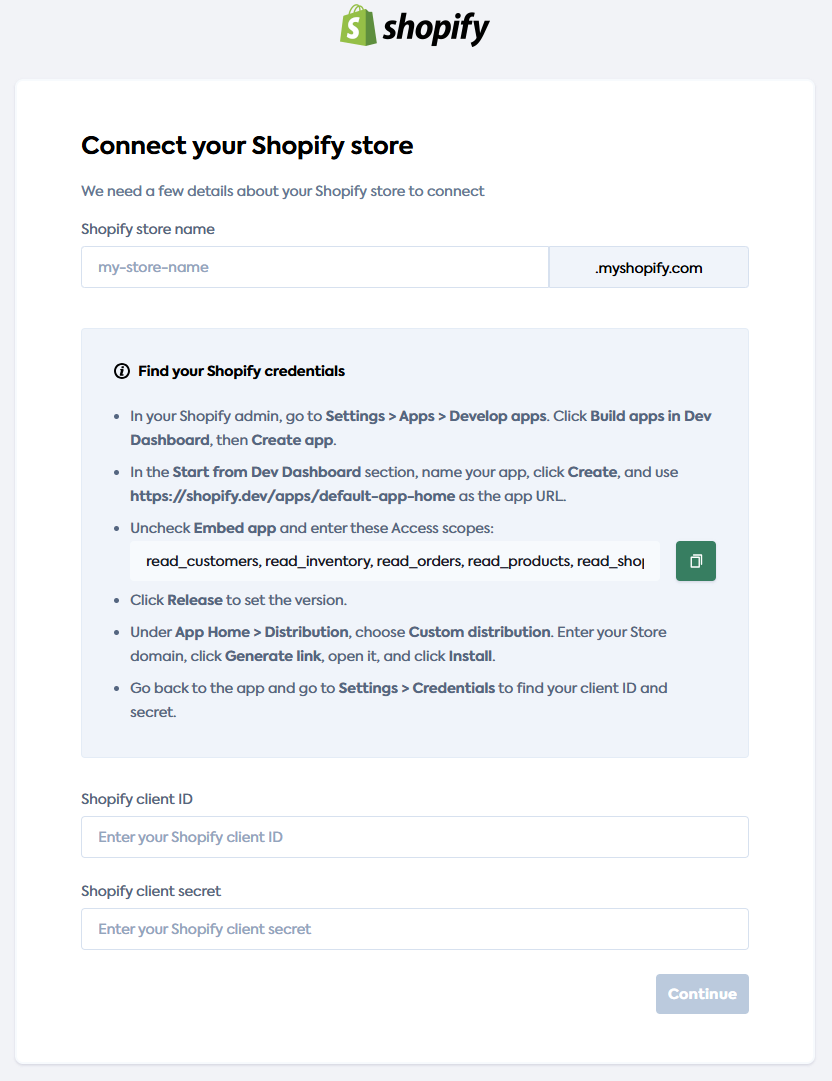
The merchant is asked to create and install a custom app in their Shopify admin account and provide the store name, client ID, and client secret from the app.
The UI includes a Find your Shopify credentials section that guides the merchant through the process. For more detail, see the Shopify docs on Custom apps (Create a custom app and Install a custom app) and Select a distribution method. The merchant needs to complete the following steps.
Create and configure the custom app
-
From your Shopify admin, go to Settings > Apps.
-
Click Develop apps.
-
Click Build apps in Dev Dashboard.
-
From your Dev Dashboard, click Create app.
-
In the Start from Dev Dashboard section, name your app, and then click Create.
-
Create a version for your app:
- App URL:
https://shopify.dev/apps/default-app-home - Uncheck Embed app in Shopify admin
- In the Access section, enter these app scopes:
read_customers, read_inventory, read_orders, read_products,
read_shopify_payments_payouts, read_shopify_payments_disputes - Click Release
- (Optional) Enter a version name and a version message
- Click Release
- App URL:
Select Custom distribution and install the app
-
Go to App Home > Distribution and click Select distribution method.
-
Choose Custom distribution and click Select.
-
In Store domain, paste your store domain and click Generate linkLink The authorization flow that allows end users to connect their accounting, banking, or commerce platforms to your application via Codat..
-
Copy the generated linkLink The authorization flow that allows end users to connect their accounting, banking, or commerce platforms to your application via Codat. and open it in your browser.
-
Choose your store and click Install.
Get the client ID and secret
- Go back to the app and go to Settings > Credentials to find your client ID and secret.
Complete the connectionConnection A link between a Codat company and a data source (like an accounting platform). Each connection represents authorized access to pull or push data from that platform. in Codat LinkLink The authorization flow that allows end users to connect their accounting, banking, or commerce platforms to your application via Codat.
Next, the merchant needs to:
-
Enter their store name in the Shopify store name field (the part before
.myshopify.com—for example,my-store-name). -
Enter the Shopify client ID from the app’s Settings > Credentials.
-
Enter the Shopify client secret from the app’s Settings > Credentials.
-
Click Continue to submit the store name, client ID, and client secret to Codat.
The LinkLink The authorization flow that allows end users to connect their accounting, banking, or commerce platforms to your application via Codat. success screen is displayed if the custom app was connected successfully.
Overview of integration setup
To set up the Shopify integration using custom apps, you'll need to:
- Check the required permissions for merchants.
- Configure the Shopify integration without entering any credentials, and then enable it.
- Check the commerce syncSync The process of fetching the latest data from a connected data source. Syncs can be triggered manually or run automatically on a schedule. settings
- Send LinkLink The authorization flow that allows end users to connect their accounting, banking, or commerce platforms to your application via Codat. URLs to your merchants.
Required permissions for merchants
Merchants must have the following permissions to connect their Shopify store and share commerce data.
-
The Enable app development permission (required to enable custom app development).
-
The Develop apps permission.
-
Any staff permissions required by the access scopes listed in Create and configure the custom app.
Configure the Shopify integration for use with custom apps
To configure the Shopify integration for use with the custom apps approach:
-
In the Codat Portal, go to the Commerce integrations page.
-
Locate Shopify and select Manage to view the Integration settings page.
-
Leave the App URL, Client ID, and Client secret fields blank.
-
Leave the Has request to read all orders toggle switched off.
Orders read by defaultAll orders are available to read from Shopify by default when using the custom apps connectionConnection A link between a Codat company and a data source (like an accounting platform). Each connection represents authorized access to pull or push data from that platform. method.
-
Click Save.
-
Enable the integration by setting the toggle to Enabled.
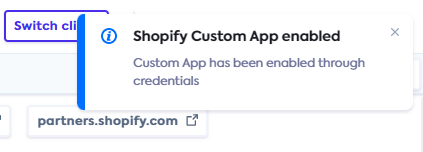
If the integration was enabled successfully, the Shopify Custom App enabled message is displayed at the top right:
Check the commerce syncSync The process of fetching the latest data from a connected data source. Syncs can be triggered manually or run automatically on a schedule. settings
All commerce data types must be enabled before you can read commerce transactions from Shopify to Codat. Follow the steps in Commerce sync settings; you only need to do this once.
Next steps
Test your Shopify integration before sending LinkLink The authorization flow that allows end users to connect their accounting, banking, or commerce platforms to your application via Codat. URLs to merchants.